
Article 11
14th: Ava DuVernay on the 14th Amendment
14th is Ava DuVernay's documentary on the long fight over the 14th Amendment and who gets to belong. Limited release 27 November, on Netflix 4 December 2026.
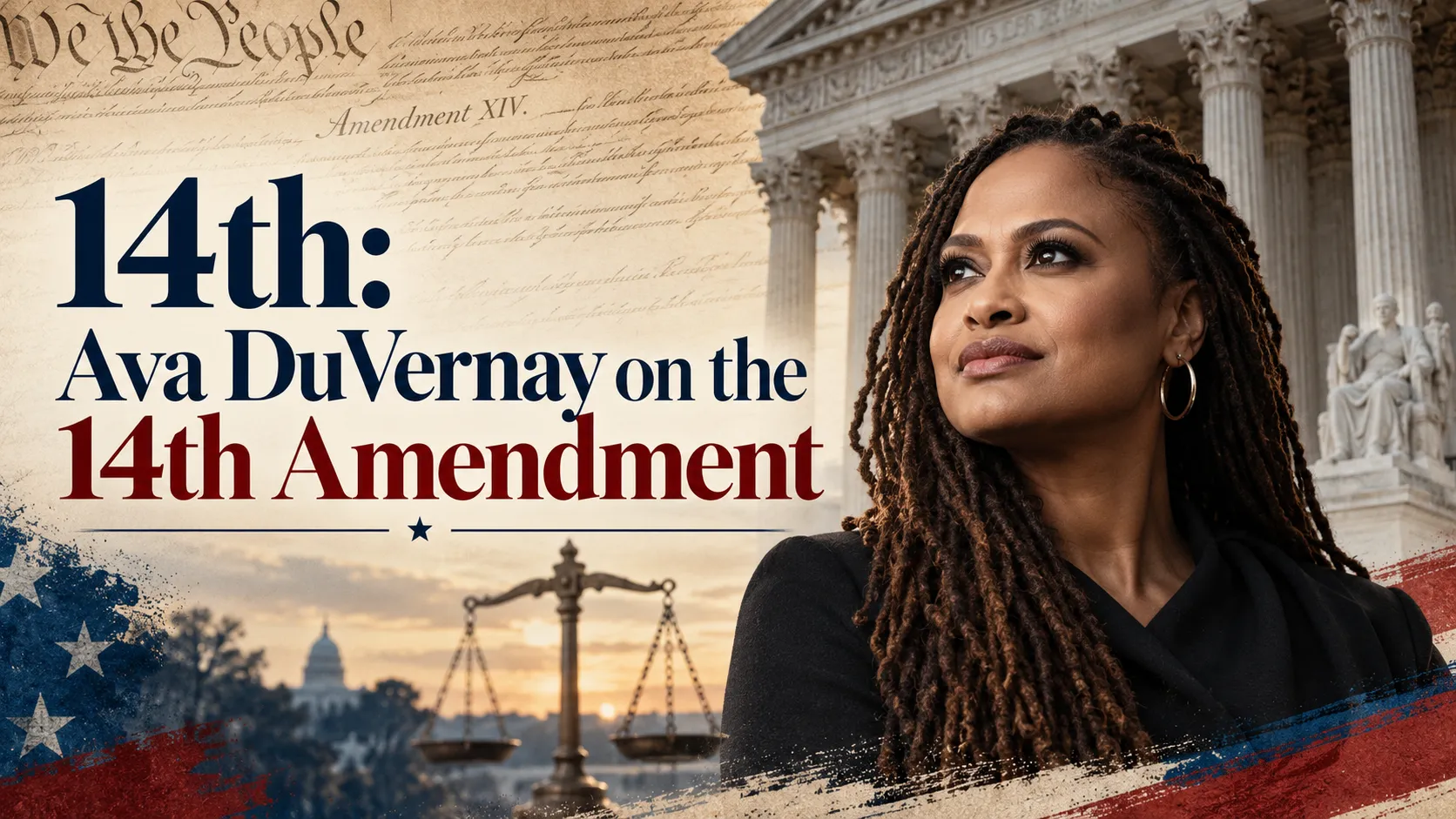
14th: Ava DuVernay on the 14th Amendment
14th is Ava DuVernay's 2026 documentary about the U.S. Constitution's 14th Amendment, a pivotal part of American legal history that DuVernay analyzes for its meaning and interpretation.
2026 is the year DuVernay revisits the U.S. Constitution after the 2016 release of her documentary 13th which analyzed race, and also constitutional history and American legal issues by focusing on questions of citizenship and legal process. Unlike 13th, which limited its focus to the Reconstruction-era amendment, 14th takes on the nation's issues of the present, including, politics, law, and social movements.
14th will be released on Netflix December 4th. It debuts in U.S. theaters on November 27th.
What is the Fourteenth Amendment?
Ratified in 1868 at the end of the Reconstruction period after the American Civil War, the Fourteenth Amendment is one of the most important amendments in American history. The amendment addresses the rights of citizenship and the constitutional protection of due process and equal protection. Because of the nation's political and social division on the interpretation of the amendment, historically, lawmakers and judges have not always been able to agree on its meaning.
Because of the division in the nation, and its history on the interpretation of the Fourteenth Amendment, DuVernay's documentary covers a wide range of issues.
The documentary looks at numerous elections, court cases, presidents, and political parties. Instead, as documented by Netflix, it looks at how one of the earliest and most profound constitutional cases is repeated, from researching the past, to tracking present-day events. (Netflix)
People finding the documentary through general entertainment searches like Moviebox, likely have little or no knowledge of the legal and constitutional cases documented in the film. Knowing this, it becomes easier to understand why the documentary skips between different time periods.
DuVernay Returns to Constitutional History
Ava DuVernay directs and produces 13th, through her production company ARRAY, along with Spencer Averick, Tammy Garnes, and Paul Garnes. (Netflix)
DuVernay's 13th focused on the Thirteenth Amendment and the history of incarceration in the US. For 14th, the focus is on another constitutional amendment and a different set of issues.
DuVernay has stated that her goal with 14th was to ask "Who is counted? Who is considered part of the country?" (Netflix)
With this framing, the amendment becomes a tool to understand citizenship and belonging, as opposed to just a historical legal document. (Netflix)
Netflix has categorized 14th as a cultural and social documentary, due to its length of approximately 100 minutes. (Netflix)
More Than 50 Interviews Bring A Lot of Diversity
Perhaps the most important thing about 14th, is the variety of people interviewed.
Netflix says DuVernay conducted over 50 interviews with historians, lawyers, scholars, cultural observers, and political figures, some of whom are current or former Democratic and Republican officials and lawmakers. (Netflix)
Some of the people interviewed include U.S. Representatives Alexandria Ocasio-Cortez and Anna Paulina Luna, former Senator Jeff Flake, Senator Alex Padilla, legal scholar Sherrilyn Ifill, historian Eric Foner, historian David Blight, Robert Chang, Stacey Abrams, Donald T. Critchlow, and Hasan Piker. (Netflix)
The 14th amendment was created to resolve uncertainty and disagreements in understanding the Constitution.
That's important to understand, because most of the time when there are competing legal and political interpretations of the Constitution, what's being disputed is whether or not a particular interpretation of the Constitution is valid, and not that a given interpretation is the only correct one.
The Documentary Connects History With Current Questions
The 14th Amendment was adopted as part of the Reconstruction Amendments to the U.S. Constitution. Netflix says 14th is a blend of archive-based research and contemporary journalism. (Netflix)
It's important to note the interviews were conducted to help answer why current ongoing disputes about citizenship and rights in America continue to exist more than 100 years after the language of the 14th Amendment was written.
Understanding the 14th Amendment is critical to understanding the development of modern constitutional law. Due to the evolution of legal and constitutional interpretations of the 14th Amendment over time, it's important to consider what the amendment meant when it was drafted as well as how it's been interpreted and applied later.
There will be a world premiere of DuVernay's latest documentary, 14th, on October 9, 2026 at the New York Film Festival. It will also be shown in theaters and on streaming services later that year.
14th was selected to be the closing night film at the 64th New York Film Festival. The director's return to the festival is in celebration of the 10 year anniversary of the release of her last film, 13th.
After the festival, 14th will have a limited release starting on November 27 of that year. Netflix is expected to release the documentary and set the run time to 1 hour and 40 minutes.
Many people will be searching for the release of the documentary 14th in conjunction with other television and theatrical releases. This has led to confusion over the premiere of the documentary, its theatrical release and when it will be available on Netflix.
14th has finally been released on Netflix!
On December 4 of that year, 14th will be released on Netflix and focus on the struggle for the U.S.'s ongoing definition of belonging and citizenship, intertwined with the history of the Fourteenth Amendment.
14th will interest people with a passion for constitutional law, U.S. history and the civil rights movement as it shows the ongoing relevance of constitutional history. Rather than dismissing the intertwined history of constitutional law and the U.S., 14th will show how relevance and debate surrounding constitutional language has continued more than a century after its ratification.